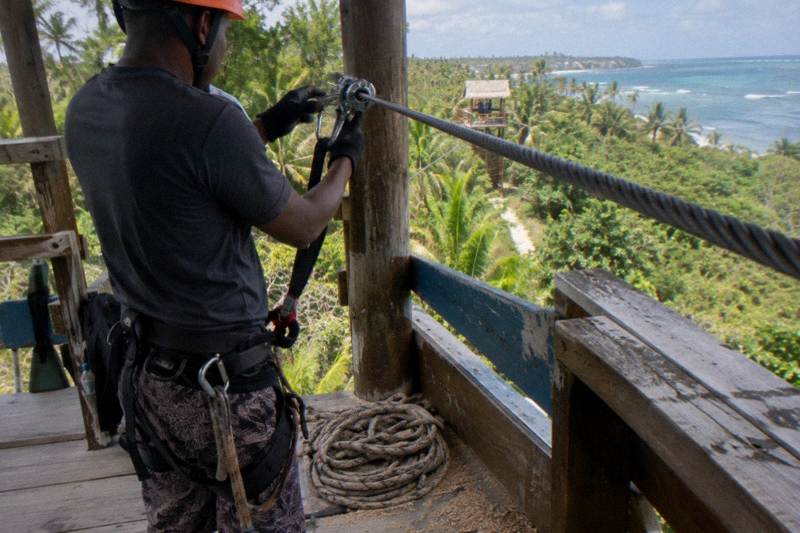
Do Heavier People Go Faster On Ziplines?
The plain-language physics of why rider weight changes zipline speed, and how Punta Cana operators manage it with braking, limits and equipment.
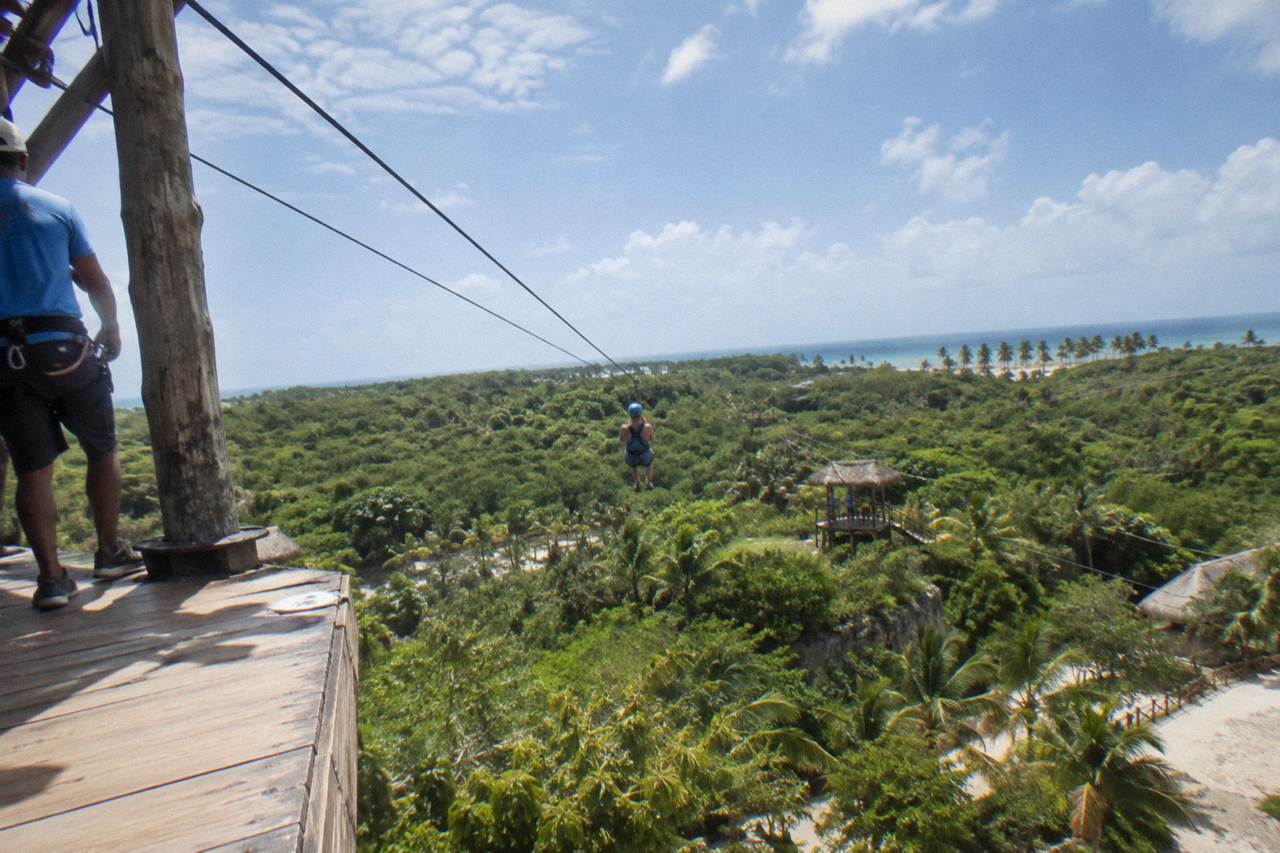
In general terms, yes: on the same cable, a heavier rider can travel faster or reach farther toward the low point of the line than a lighter rider launched from the same spot. That is simple physics, not a flaw, and it is the reason zipline operators publish weight ranges, use braking systems and position guides at the arrival platforms. Punta Cana listings handle it explicitly, with each tour stating its own limits. Weight is just one of the health factors operators screen for, and if pregnancy is a question for your group, the guide to ziplining in Punta Cana while pregnant lays out what the tours actually say and what you can do instead while everyone else flies.
The short answer comes down to two forces pulling in opposite directions. Gravity pulls every rider down the slope of the cable, and it pulls proportionally to mass, so a heavier rider has more gravitational force acting on them. Drag, meaning air resistance and the friction of the trolley on the cable, works against that pull. For a heavier rider, the opposing forces grow more slowly than the driving force does, so the net result is that the heavier rider can gain speed more easily and carry it farther along the line.
Most Punta Cana listings do not publish speed figures for their cables, though the La Hacienda Park listing quotes speeds of up to 70 km/h on its 2 kilometer lines. What the listings do publish, consistently, is the other half of the equation: the weight, height and waist limits each tour enforces. The 12-cable jungle circuit by Runners Adventures, for example, states a maximum weight of 127 kg (280 lb) and a maximum waist circumference of 112 cm (44 inches), and children between 6 and 12 ride only the first 8 cables. Those numbers exist partly because of harness fit and partly because of speed management at the arrival platform.
For a reader weighing whether their body type suits the activity, the practical takeaway is encouraging rather than limiting. Weight affects your ride, it does not disqualify you automatically, and the ranges on most Punta Cana listings are wide enough to cover most adults. The dual side-by-side adventure by the same operator, Runners Adventures, states a maximum of 285 lbs and a 44 inch waist maximum on its listing. If you fall inside a tour's stated range, the operator's equipment and braking are designed around riders like you.
There is a fuller treatment of the physical limits on the site already, in the guide to Punta Cana zipline weight limits, which walks through every listing on this site that publishes a limit. This article stays on the physics and the operational side: why weight matters, how guides use it, and what a heavier or lighter rider should actually expect on the day.
What Actually Determines Your Speed On A Zipline?
Four things set your speed, in rough order of importance: the slope and length of the cable, your weight, the braking and arrival system, and environmental conditions such as wind and rain on the cable. Rider weight is one input among several, and operators control the others deliberately, which is why the same course can serve riders of very different sizes on the same morning.
The slope does most of the work. A cable rigged with a steeper drop converts more of gravity's pull into forward motion, so every rider on it, heavy or light, moves faster than they would on a shallow line. Course designers choose the slope with the expected rider range in mind, and Punta Cana courses in the Anamuya Mountains are rigged for a broad mix of guests. One listing for the Runners Adventures course describes 18 platforms and 12 zip lines, with the longest line spanning 800 meters; another listing for the same operator describes the course differently, with 8 ziplines whose two longest spans combine to about 2 kilometers. The counts conflict between listings, so treat each as what that listing says rather than a fixed fact about the course.
Weight then modifies what the slope delivers. The classic playground intuition, that a heavy ball and a light ball fall at the same rate, applies in a vacuum, but a zipline is not a vacuum. Air resistance depends on your shape and size, not your mass, while gravity's pull depends on your mass. A heavier rider therefore gets more pull for roughly the same drag and can accelerate harder and hold speed longer. This is also why a very light rider sometimes stalls short of the platform on a long line, and why operators publish minimum weights as well as maximums. The Monkeyland and zipline combo listing, for instance, states a minimum weight of 20 kilograms (44 lbs) alongside its maximum of 127 kilograms (280 lbs).
The arrival system is where the operator takes over. Modern courses use braking at the platform end, and guides stationed there control each rider's arrival, telling them to sit back, lift their legs or hold the brake line as needed. A rider arriving hot, meaning fast, is an expected scenario the guides train for, not an emergency. Dominican adventure tourism regulation requires operators to hold certification for zipline circuits, with certified guides trained in rescue and first aid, under requirements published by the Ministry of Tourism in its adventure tourism requirements document. Runners Adventures renewed its ACCT safety certification for its zipline circuits in October 2026, according to a report in a Dominican daily.
Finally, weather plays in. A wet cable changes friction, and a headwind slows a light rider more than a heavy one. Operators judge conditions on the day, and listings state that tours can be rescheduled or refunded in cases of extreme weather. If you want the fuller picture on riding in wet conditions, the site's piece on ziplining in the rain in Punta Cana covers what changes.
| Factor | How it changes your speed | Who controls it |
|---|---|---|
| Cable slope and length | Steeper and longer lines build more speed for every rider | Course designer, fixed on the day |
| Rider weight | Heavier riders can accelerate more and carry speed farther; very light riders may stall on long lines | You, within the listing's stated range |
| Braking and arrival setup | Guides and platform brakes absorb arrival speed | Operator's guides, every ride |
| Cable condition and wind | Rain or headwind changes friction and drag | Operator's weather judgement |
Weight is the factor readers ask about most, so it is worth being precise about what it does and does not change. It does not change whether you can ride; that is the listing's limit range. It does not change the course, the platforms or the views. It changes your acceleration profile on each line, and the operator's systems are built to absorb exactly that variation.
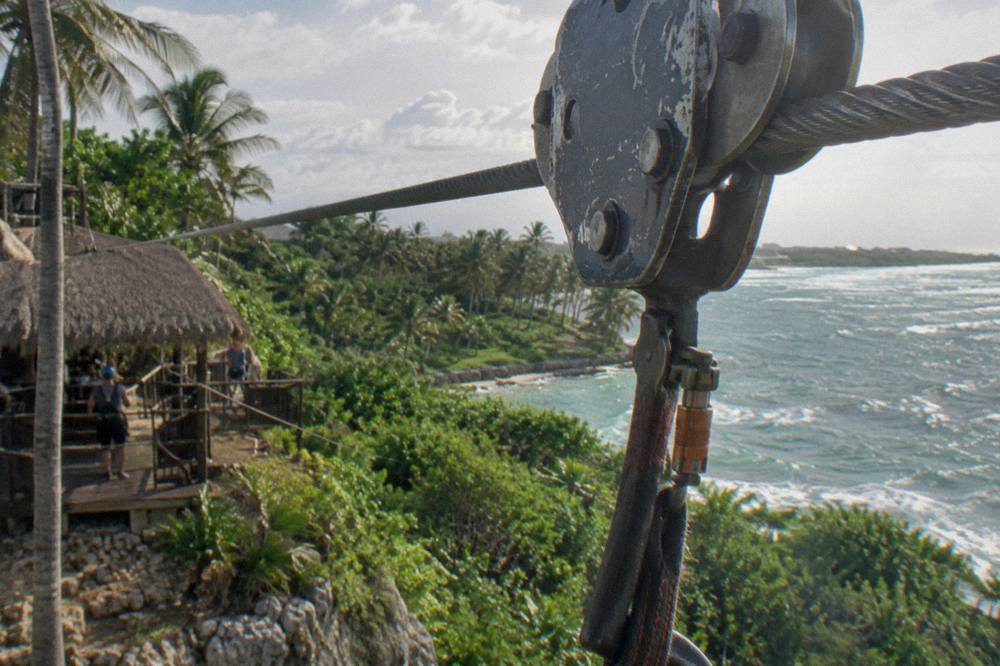
How Do Punta Cana Operators Manage Rider Weight And Speed?
Operators manage the weight-speed relationship with three tools: published weight limits per listing, guides on the course, and equipment designed around the stated rider range. Nothing about a heavier rider's ride is left to chance; the limits exist precisely because speed at arrival scales with mass, and the whole system is rigged to keep every arrival within what the platform team can receive.
Start with the limits themselves, because they are the clearest evidence that operators think about weight constantly. Every weight figure here is operator-specific: Dominican licensing rules cover certification and guide training but set no national weight limit, and the numbers differ listing to listing. The suspension bridge course states ages 5 and up with a maximum weight of 300 lbs. The Zip Line Park listing states a maximum of 270 pounds. The Bavaro Adventure Park listings state a maximum of 130 kilograms with a minimum participant height of 1.30 meters (4.27 ft), and a minimum age of 18 with a valid licence for anyone driving a buggy. These are not interchangeable numbers; they are each tour's own engineering envelope.
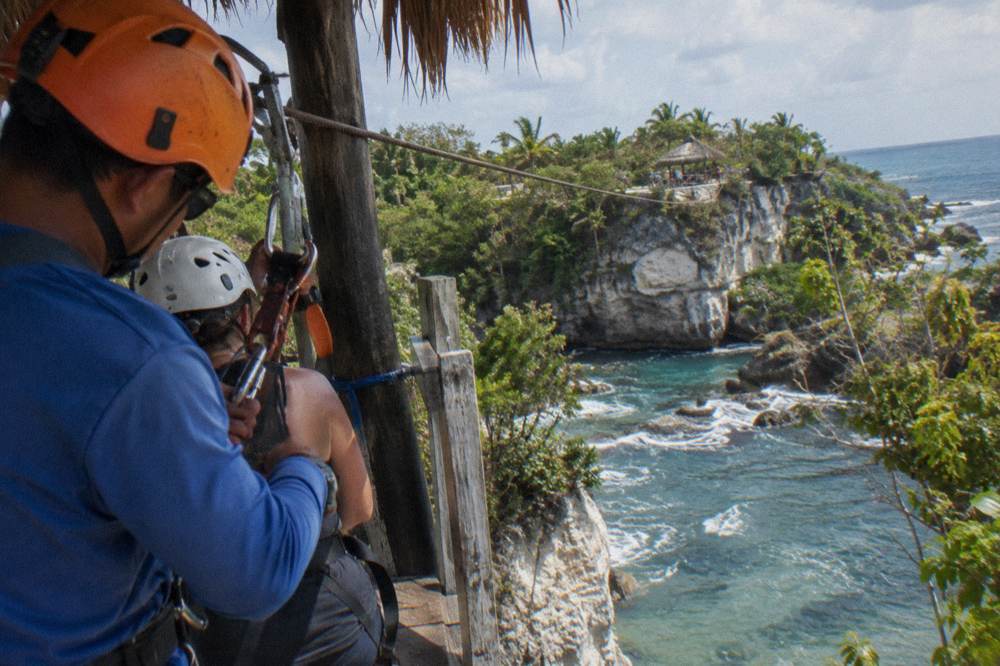
Then there is the staffing model. On the 12-cable circuit, the listing names experienced guides and a safety briefing before the first platform, and on courses like this staff at each platform typically control the arrival and connect the next line. The listing for that tour includes experienced guides among its inclusions, alongside transportation from and to your hotel, water, soft drinks and fresh fruit. The presence of a guide at the receiving end is the visible half of speed management: they watch each rider come in, adjust instructions rider by rider and slow arrivals as needed with the platform's brake.
Equipment is the third tool. Harnesses, helmets and trolleys are sized and rated for the stated rider range, and the waist circumference limits that several listings publish, 112 cm (44 inches) on the 12-cable circuit and the dual side-by-side adventure, exist because a harness only restrains a rider it actually fits. The dual adventure, rated 4.8 from 606 reviews and priced from $90 per person for a 6 hour day, states a maximum of 285 lbs and a 44 inch waist maximum on its listing.
It is also worth saying what does not happen. Listings here do not describe on-site weighing as a universal practice, and this site does not claim it. Some riders ask whether they get weighed before ziplining; the honest answer is that it depends on the operator, and the blog post on getting weighed before ziplining covers what the listings actually say. Where a listing is silent, check with the operator before booking rather than assuming.
The dual side-by-side adventure earns its solo mention here because it is sold as a side-by-side experience, though one reviewer found only one of its 12 lines was a dual cable. Two guests ride parallel cables, which turns the physics into a shared experience: whatever the difference in their masses, each arrives into the same braking system with a guide waiting. The listing includes bottled water, official tourist guides, transportation and safety equipment, with hotel pickup listed and free cancellation listed.
What Are The Weight Limits On Punta Cana Ziplines?
Every limit is set by the individual listing, not by any country-wide rule. Among the tours compared here, they range from a 270 pound maximum on one park listing to a 300 pound maximum on the suspension bridge course, with several listings clustered at 127 to 130 kilograms, roughly 280 to 287 pounds. Waist limits of 112 cm (44 inches) and minimum heights of 1.30 meters appear on some listings and not others.
The table below gathers the limits exactly as each listing states them. Read one row at a time: each line describes one product's rules, and nothing in the table generalizes to a second product. Where a listing says nothing about weight, the row says so, and the right move is to check the listing.
| Listing | Weight rule as stated | Other stated limits |
|---|---|---|
| 12-cable jungle circuit (Runners Adventures) | Maximum 127 kg (280 lb) | Max waist 112 cm (44 in); children 6 to 12 ride only the first 8 cables |
| Dual side-by-side adventure (Runners Adventures) | Maximum 285 lbs | Maximum 44 inch waist |
| Monkeyland and zipline combo (Runners Adventures) | Minimum 20 kg (44 lbs), maximum 127 kg (280 lbs) | Minimum age 6; max waist 112 cm (44 in) |
| Monkeyland, Ziplines and Buggies bundle (Runners Adventures) | Minimum 20 kg (44 lbs), maximum 127 kg (280 lbs) | Minimum age 6 |
| Zip Line Park (Best Punta Cana Vacations) | Maximum 270 pounds | Not stated beyond weight |
| Suspension bridge course (Sol Playa tours) | Maximum 300 lbs | Ages 5 and up |
| Bavaro Adventure Park zipline listings | Maximum 130 kg (280 lb) | Minimum height 1.30 m (4.27 ft); buggy drivers 18 plus with licence |
Two patterns are worth noticing. First, minimums exist for the same reason as maximums: a rider below the minimum weight may not carry enough momentum to complete a long line, particularly into a headwind. Second, the numbers cluster tightly even though no rule forces them to, which reflects shared equipment standards across the industry rather than a Dominican regulation. Scape Park's own rules page, for example, publishes its zipline limits as minimum 60 lbs, maximum 280 lbs and a minimum height of 4 ft, and Bavaro Adventure Park's information page states its 130 kg maximum and 1.30 m minimum height. Different operators, similar envelopes, independently stated.
If your weight is near a limit on either end, the practical advice is simple: check the listing, then message the operator before booking. The listing is the binding document, and the operator's confirmation is what settles borderline cases. The site's guide to zipline age limits in Punta Cana applies the same logic to families weighing up children's participation.
Do Heavier Riders Need Different Technique Or Equipment?
Mostly no: heavier riders use the same harnesses, helmets and trolleys as everyone else, within the listing's stated range, and follow the same instructions. The differences are at the margins. A heavier rider may be asked to adopt a more streamlined body position on fast lines, and a lighter rider may be told to tuck less or hold a brake line earlier, because guide instructions are tuned rider by rider.
The briefing is where this happens. Every listing here that describes its safety setup mentions a briefing or training element before the first line: the 12-cable circuit lists experienced guides, the canopy adventure listings list a safety briefing and training session, and the park passes list equipment plus training as part of admission. During that briefing, guides cover the riding position, usually sitting back in the harness with legs forward, hand positions and the arrival posture. Riders hear the same core instructions regardless of build.
What varies is the fine-tuning. Guides on the platform adjust per rider: a heavier rider may be sent off in a flatter, less tucked position to shave arrival speed, or launched from a specific spot on the platform. A lighter rider may be told to keep still, because light riders are more sensitive to cable bounce and crosswind. None of this is special treatment; it is the same operational physics described above, applied by people who run the same lines dozens of times a day.
Equipment sizing is the one place weight genuinely changes the experience. A rider whose waist exceeds the harness range on a given listing cannot ride that tour, which is why the waist figures are printed as prominently as the weight figures. Within range, the equipment is identical. There is no heavyweight trolley, no reinforced cable reserved for heavier guests, and no separate launch procedure described on any listing among the tours compared here.
One honest note on fitness, which several listings address directly: tours require moderate physical fitness, and reviews of the Monkeyland combo note the jungle walks between platforms get warm and sweaty. That is true for every build. The site's guide on what to wear ziplining in Punta Cana covers closed-toe shoes, comfortable clothes and the locker situation for personal belongings, none of which changes with rider weight.
Does Weight Change Where You Stop On The Line?
Yes, and this is the most practical consequence of the whole physics discussion. On a given cable, a heavier rider tends to arrive at the far platform with more speed to spare, while a very light rider can fall short and need a guide's help to finish the line. Both outcomes are routine, both are handled by platform staff, and neither is dangerous when the course is run within its stated weight range.
Arrivals are the whole reason guides station themselves at the receiving end. The guide watches the rider approach, calls the arrival posture and manages the final meters. When a rider comes in fast, the brake setup absorbs the surplus. When a rider stalls short, the guide retrieves them, typically by pulling the line or re-launching the rider from a platform step. Guests who read reviews of Punta Cana zipline tours will occasionally see mentions of a slow arrival or an assisted finish; these are operational moments, not incidents.
This is also why minimum weights matter as much as maximums on the listings that publish them. The Monkeyland and zipline combo, rated 4.8 from 1,227 reviews and from $130 per person for an 8 hour day including lunch, states its 20 kg minimum right beside its 127 kg maximum. The bundle version, the Monkeyland, Ziplines and Buggies Adventure Bundle at 4.9 from 13,839 reviews and from $209 per person, states the same range. A rider under the minimum is not being excluded for safety theater; the operator knows from experience that the lightest cables on the course may not carry them across.
For mid-range riders, meaning the large majority of adults, weight is close to a non-issue on the day. The differences described here are real but small, and the design of the course, the slope choices, the braking and the staffing, exists to make every ride within the range feel the same at the platform. If you are deciding between courses, the comparison of zipline versus canopy tours in Punta Cana explains how the two formats differ in pace and terrain, which affects perceived speed more than a few kilograms ever will.
What Should A Weight-Conscious Rider Do Before Booking?
Check the listing's stated limits first, message the operator with any borderline question second, and pick a tour whose stated range you sit comfortably inside rather than at the edge of. That three-step habit resolves nearly every weight question before money changes hands, and it takes about ten minutes.
Step one is reading the actual listing. Every figure in the table above comes from a live listing, and listings sometimes revise their terms, so the number that binds your booking is the one on the operator's page when you book.
Step two is the pre-booking message. Operators answer borderline questions all the time: a rider just under a listed maximum asking whether they are safely inside the envelope, a parent asking whether a child's build suits the children's cable rule, a guest who cannot find a waist figure on a listing that does not publish one. A short message settles it, and the written reply is worth keeping with your confirmation.
Step three is choosing with margin. The suspension bridge course, from $75 per person for a 3 hour tour with hotel pickup and a fruit bowl included, publishes the most generous stated maximum of any listing here, at 300 lbs. The half-day zipline from $70 per person and the canopy adventure from $69 per person do not publish weight figures at all, which makes the pre-booking message more important on those, not less. The 12-cable circuit, the featured tour on this page at 4.5 from 236 reviews and from $90 per person, publishes its limits clearly, which is itself a small service to the weight-curious reader: you know the envelope before you commit.
A quick reassurance on cancellation: every listing cited in this article shows free cancellation in its terms, so a pre-booked tour is not a locked door if your plans or your questions change. The site's overview of Punta Cana zipline tour prices puts the full price ladder in one place if you are weighing cost alongside limits.
Common Questions About Ziplines And Rider Weight
Do Heavier People Go Faster On Ziplines?
In general, yes: on the same cable, a heavier rider can accelerate more and carry speed farther than a lighter rider, because gravity's pull scales with mass while drag does not. Operators account for this with published weight limits, braking at arrival platforms and guides who adjust instructions rider by rider.
Do Punta Cana Zipline Tours Have A Weight Limit?
Each listing sets its own. On this site, stated maximums range from 270 pounds on the Zip Line Park listing to 300 pounds on the suspension bridge course, with several listings at 127 to 130 kg. Several also publish waist limits, commonly 112 cm (44 inches). Check the specific listing before booking.
Is There A Minimum Weight For Ziplining?
On the listings that publish one, yes. The Runners Adventures Monkeyland and zipline combos state a minimum of 20 kg (44 lbs), because very light riders may not carry enough momentum to finish longer lines. Listings without a stated minimum should be checked with the operator directly.
Will I Be Weighed Before The Tour?
It depends on the operator, and no listing here describes on-site weighing as a universal practice. Where a listing is silent, ask the operator before booking rather than assuming either way.
Does Weight Change Which Tour I Can Book?
Only at the edges of each listing's stated range. Within the range, equipment and procedures are identical for every rider. If your weight sits near a limit on either end, choose a tour whose published range you sit comfortably inside, or message the operator before booking.
Do Heavier Riders Need A Special Harness Or Trolley?
No. Within a listing's stated range, all riders use the same harnesses, helmets and trolleys. The only weight-driven equipment issue is fit, which is why several listings publish a waist circumference maximum alongside the weight figure.