Is Zip Lining Scary For Beginners?
An honest look at what first-time zipliners feel on the cables around Punta Cana, which shorter and gentler tours suit nervous beginners, and how guides and equipment carry you through the first line.
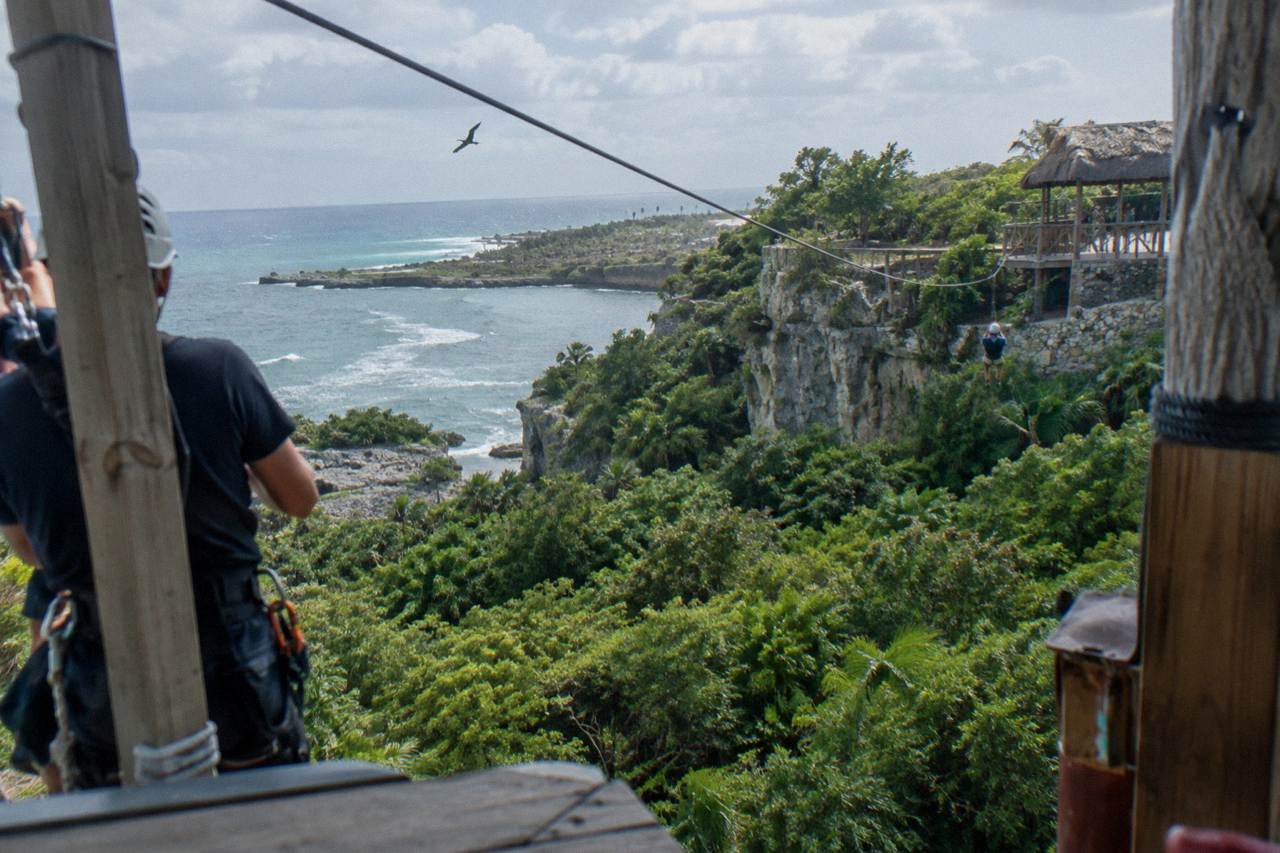
Most first-timers arrive at a zipline base with their stomach somewhere near their throat, and most of them are laughing by the third cable. That gap, between the fear on the walk up to the first platform and the grin halfway through the circuit, is the entire story of beginner ziplining. It is a real fear, and it usually fades faster than people expect, because the equipment does the holding and the guide does the deciding.
This page looks at what beginners actually report feeling, what the listings around Punta Cana say about course length and pace, and how the harness, helmet and briefing turn a scary idea into a manageable afternoon. The short answer for anyone skimming: yes, the first line feels scary for a minute or two, no, it does not usually stay that way, and there are specific short courses built for exactly this situation.
Yes, but usually only for about two minutes, and almost never for the whole tour. The scariest part for beginners is not the ride itself, it is the pause on the first platform when you clip in, look down the cable, and wait for the guide's signal, and guest reviews of Punta Cana courses repeatedly describe nerves before the first line and surprise at how fast the fear turns into enjoyment.
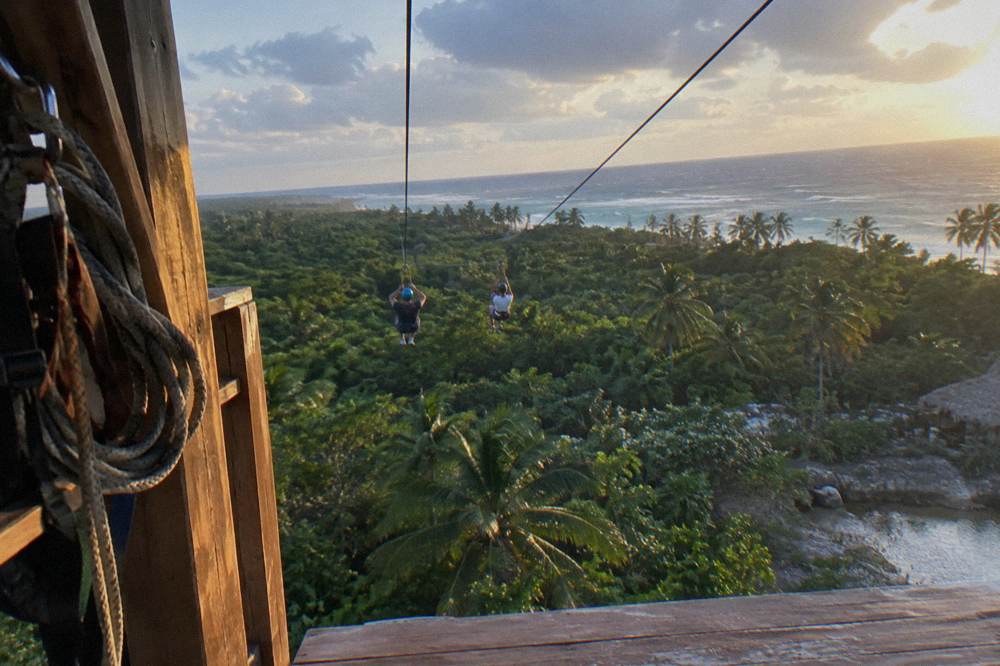
What makes that first pause feel worse than the reality is a set of predictions the brain makes that turn out to be wrong. Beginners tend to expect a drop, the stomach-lurch of a rollercoaster. A zipline is not a drop, it is a controlled descent along a taut cable that the operator has rigged to a receiving platform lower down. You sit into the harness, you slide, and the ride is smoother than the word flying suggests. Many first-timers find that watching one or two people go first from the same platform takes much of the edge off.
The second wrong prediction is about control. On the platform you feel responsible; on the cable you are not. Guides clip you on, guides give the launch signal, and on the courses around Punta Cana the receiving end is staffed, so braking is not a beginner's job on the standard circuits. The listings describe exactly this arrangement: a safety briefing and a training cable before the circuit, certified guides on the platforms, and double-line cables on many of the mountain courses. The Dominican adventure-tourism framework also requires certified guides with rescue and first-aid training and annual technical inspection of circuits, per the Ministry of Tourism's adventure requirements at its published adventure-tourism requirements.
The third wrong prediction is about duration. The frightening part, the anticipation, is measured in minutes. One listing's itinerary gives roughly 2.5 hours for the full zipline activity including the guided walk through the mountains and vegetation between platforms, and the individual rides are seconds long each. The fear gets compressed between two short moments: standing on the platform, and the first second of motion. After that, most beginners are busy looking at the jungle.
For a first taste, a short shared canopy course is the low-commitment option, and Punta Cana has several at the gentle end of the scale:
What Does The First Line Actually Feel Like?
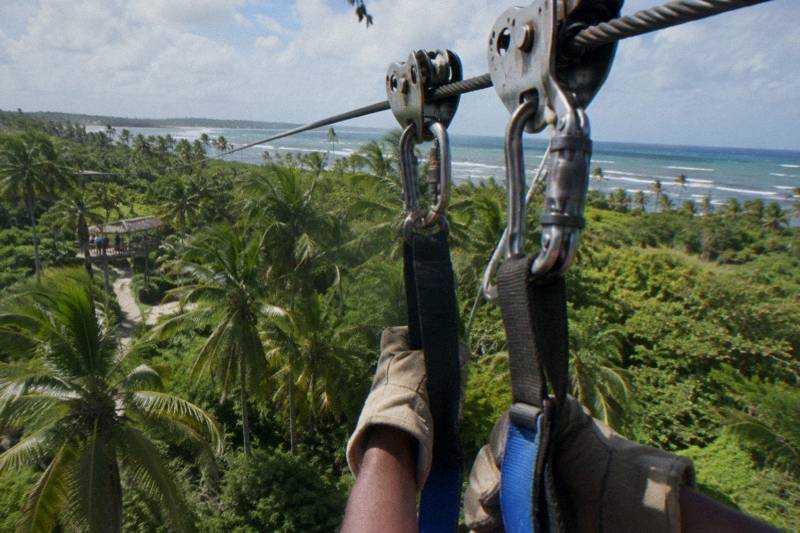
The first line feels like stepping off a low ledge while attached to something solid, followed by a fast, smooth glide that lasts only seconds. The harness takes your weight before you move, and the launch is a small step or push rather than a jump. Reviews describe the sensation as seated rather than dropping, like resting in a swing that happens to be moving.
Walking to that first platform is, honestly, the harder part. The mountain courses involve guided walks between platforms on paths and stairs through vegetation, and reviewers note getting warm and sweaty during these stretches. That walk gives the fear time to build, but it also gives the guides time to work: they fit and check harnesses, repeat the briefing, and usually send a demonstrator or the most nervous volunteer down a short first cable while everyone watches. On the 12-cable mountain circuit the listing states that children between 6 and 12 years old ride only the first 8 cables, which tells you something useful: the opening lines of a course are the gentle ones, and the bigger lines come later, after riders have settled.
The ride itself has three phases. The launch, one step and a drop of a few centimetres into the harness. The glide, a wind noise and a view, with the jungle floor moving below at a distance that feels much larger from the platform than it does in motion. And the arrival, where the receiving-side guide brakes you, either with a rigged system or by hand, and you stand up on solid wood. Beginners who fear the arrival most often report it was the least dramatic part, a firm slow-down rather than a jolt.
Nervous first-timers often want the shortest possible commitment, and the canopy course with fruits and water is built for exactly that: 3 hours door to door, from $69 per person, rated 4.7 from 19 reviews, with private transport, safety equipment, guides, water and a fruit snack listed as included. Its operator, Kayleeg Tour and Travel, runs it as a shared tour, and the inclusions are a good picture of the beginner package: transport, gear, guide and refreshment. Free cancellation is listed on it, which matters for someone who wants the option to back out.
Which Tours Suit A Nervous First-Timer In Punta Cana?
Short courses, shared group tours, and options that include hotel pickup suit a nervous first-timer in Punta Cana best, because they limit the commitment and remove the logistics stress that compounds nerves. Together, these choices keep the day simple from start to finish, which is exactly what a beginner needs to feel comfortable. The gentlest entry points on this site are the 2.5 to 3 hour canopy circuits in the $69 to $75 range, all of which list free cancellation, and most of which list equipment, guides and refreshments. The bigger decisions, like the 6 hour dual side-by-side adventure or the full-day Monkeyland, ziplines and buggies bundle from Runners Adventures, are better saved for a second visit once the first-line fear has been paid off.
Here is how the beginner-relevant options compare on the facts that matter to nerves: total time, price, and what the listing says is included.
| Tour | Duration | From price | Rating | Beginner-relevant listing details |
|---|---|---|---|---|
| Canopy Course, Fruits and Water (Kayleeg Tour and Travel) | 3 hours | From $69 per person | 4.7 from 19 reviews | Private transport, safety equipment, guides, water, fruit snack; free cancellation listed |
| Half-Day Zipline, Fruit and Water (Los Corales Transporte turistico) | 3 hours | From $70 per person | 4.2 from 79 reviews | Hotel pickup and drop-off, equipment, guide, fruit, water; free cancellation listed |
| Dual Side-by-Side Zipline (Runners Adventures) | 6 hours | From $90 per person | 4.8 from 606 reviews | Transportation, safety equipment, official guides, bottled water; a longer day, best as a confident second tour |
| 8 Lines Plus Hanging Bridge (Hacienda Tuko) | 6 hours | From $65 per person | 5 from 1,001 reviews | Bottled water and a fruit bowl listed; the listing does not state pickup, so check the listing before booking |
A few honest notes on that table. The half-day zipline with fruit and water is the workhorse beginner option: 3 hours, hotel pickup and drop-off listed as included, and a 4.2 rating from 79 reviews, a pool large enough to read for patterns. The dual side-by-side adventure is included because it answers a specific beginner fear, going alone: side-by-side cables let two people ride next to each other at the same time, so a nervous rider can share the moment with a partner. It is a 6 hour day though, and from $90 per person it is a bigger commitment than a first tour needs to be.
The 8-lines-and-hanging-bridge listing deserves its row for a different reason: 5 from 1,001 reviews is one of the strongest review pools among these tours, and it shows that plenty of first-timers complete a 6 hour day happily. But its listing does not state pickup, and logistics stress compounds nerves, so a beginner should confirm transport on the live listing before booking rather than assuming it.
How Do Guides And Equipment Reduce The Fear?
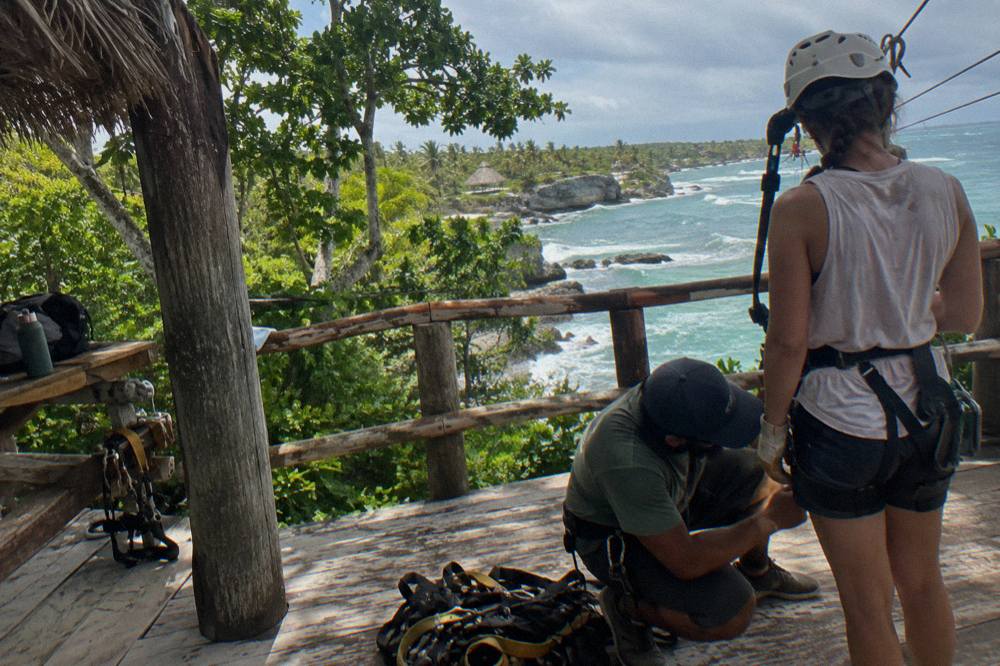
Guides reduce fear by taking over the decisions that matter: clipping you on, giving the launch signal, braking you at the far end, and setting the group's pace. Equipment reduces it by being visible, fitted by staff, and explained before you leave the ground, with Punta Cana listings consistently adding a safety briefing, a training cable, guides at both ends of each line, and, on many mountain courses, double-line cables.
For a beginner, the practical effect is that your only job is to listen. The briefing covers body position, usually a seated posture with one hand back on the cable or lanyard and legs forward for the arrival. The training cable exists precisely for the nervous: it is short, close to the ground, and its entire purpose is to let you feel the harness hold you before you are high. One listing describes its safety briefing and training session as a listed inclusion in its own right, which is the right way to read it: it is part of the product, not a formality.
The regulatory floor helps too, though it is invisible on the day. The Ministry of Tourism's adventure-tourism requirements call for annually renewed ACCT or equivalent certification, certified guides with rescue and first-aid training, documented emergency plans and technical inspections of circuits. Bavaro Adventure Park, one of the operators whose zipline tours are covered here, publishes its restrictions and safety information at its official information page, including its zipline minimum height of 1.30 m and maximum weight of 130 kg. Those limits differ listing by listing, and this site's own weight and limit rules for ziplining guide collects them operator by operator, because there is no single national norm to quote.
What the gear does not do is remove the look down. The platforms on the mountain courses sit above the canopy, and one listing describes lines reaching heights over 50 feet above the jungle floor. The fear of heights does not get engineered away, it gets managed: you can look at the horizon instead of the ground, you can say out loud that you are nervous, which guides are used to, and you can watch two or three riders go before you. Reviews written by self-described scared guests almost always mention the guide's steadiness as the thing that carried them.
What Should A Beginner Expect On The Day?
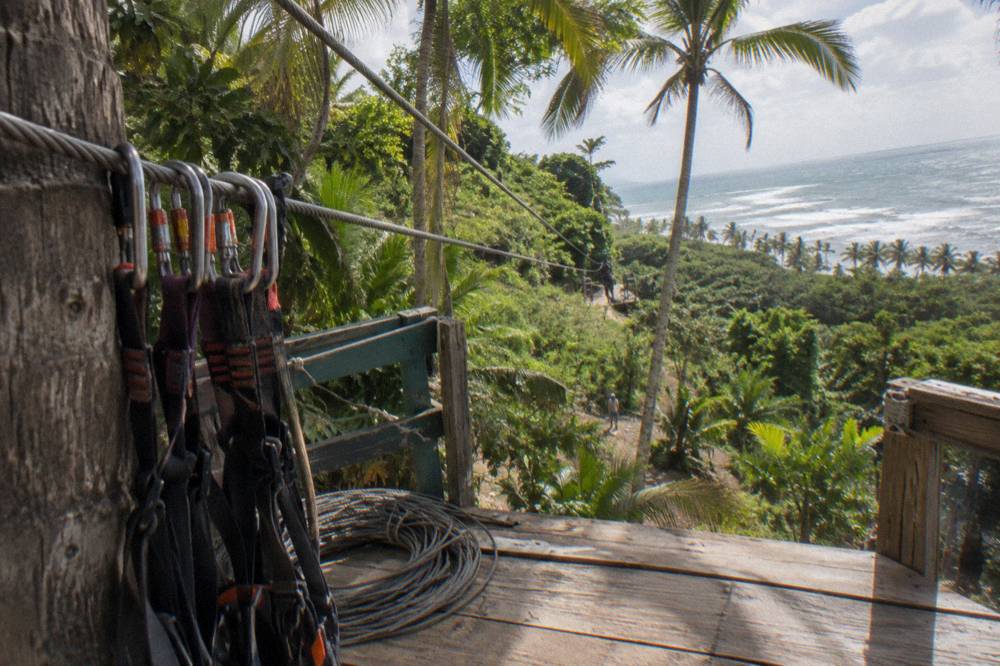
On the day, a beginner can expect a hotel pickup and a shared van or bus ride to the site, followed by a briefing and time on a training cable. A guide then leads the walk between platforms, you complete several rides lasting a few seconds each, and the day finishes with a fruit stop at the end. Most Punta Cana zipline listings include hotel pickup and drop-off, and the standard rhythm of the day is the same across operators: an early or mid-morning pickup, a transfer to the course, gear fitting, the briefing and training cable, then the circuit itself with guided walks between lines, and refreshments either on site or on the way home.
Time behaves differently than beginners expect. The rides are seconds each; the day is hours. One listing's itinerary breaks down as roughly a 40 minute transfer each way and about 2.5 hours on site for the activity, including the walking. A 3 hour tour therefore contains maybe 15 minutes of actual cable time, spread across the circuit. For anyone afraid the fear will be constant, that arithmetic is reassuring: the exposure comes in small, separated doses with recovery time on foot between them.
| Part of the day | Typical length | What a beginner feels |
|---|---|---|
| Hotel pickup and transfer | Around 40 minutes each way, per one listed itinerary | Anticipation, usually the worst stretch of nerves |
| Gear fitting and briefing | Short, before the circuit | Hands-on reassurance: harness fitted and checked by staff |
| Training cable | One short practice ride, where the listing includes it | The moment the harness is proven to hold you |
| The circuit | About 2.5 hours including walks, per one listed itinerary | Nerves on line one, easing over lines two and three, enjoyment after |
| Refreshments | Fruit and water, where the listing includes them | A wind-down with the group, and the point where most beginners plan tour two |
Weather is a fair beginner worry, and the honest answer is that rain does not automatically stop a tour. Several listings, including the La Hacienda Park ticket, state that the tour runs rain or shine, and operators describe rescheduling or refunds for extreme weather such as tropical storms rather than for showers. Atlantic hurricane season runs 1 June to 30 November per the National Hurricane Center's climate page, and this site's guide to ziplining in the rain in Punta Cana covers what changes on a wet day. What to wear is simpler than people fear: closed-toe shoes are required on the cables, and comfortable clothes plus a change for after are the standard advice, which the what to wear ziplining guide details.
Two small practical points that reviews raise. First, photos: the Hacienda Tuko combo listing bars phones and cameras unless you have an attachable kit, and operators sell photo packages; one verified reviewer noted $35 for a zipline park photo package. Budget for it or accept going camera-free, which many nervous riders actually prefer. Second, tips: several listings list gratuities as an optional extra rather than included, so bring some cash for the guides who talked you off the platform.
How Do You Calm Nerves Before The First Line?
You calm your nerves by stacking small advantages: pick a short course so the first ride feels manageable, book the morning slot before your nerves have time to gather, watch two or three others launch so you know exactly what happens, and then let the guide set the pace while your only job is to step off the platform. The reliable calming techniques from guides and guest reports all shrink the first unknown: choose a 2.5 to 3 hour circuit over a full-day bundle, go early before the heat and the overthinking build, eat something small, and say plainly to the guide that it is your first time, because they will sequence you after a confident rider and repeat the hand signals one on one.
Booking a short course is the single most useful choice. The canopy course with fruits and water at 3 hours and from $69 per person is the natural first tour, and it lists free cancellation, so the commitment is genuinely low. The half-day zipline with fruit and water, 3 hours and from $70 per person, is the same shape of day with hotel pickup and drop-off listed. Either gives a nervous beginner one clean afternoon on the cables and the option to stop there.
After that, the techniques are ordinary and they work. Breathe out at the launch step, since the fear peaks on the inhale-hold. Fix your eyes on the arriving platform, not the ground. Ask to go in the middle of the group, late enough to have watched several riders, early enough that the waiting does not stretch. Keep your hands where the briefing said, because fussing with the lanyard mid-ride is the one beginner habit guides actively correct. And treat the first line as the whole task, not the circuit: nothing after line one requires a new decision, only a repeat.
The dual side-by-side adventure deserves its mention here for a specific nerve-soothing feature rather than as a first booking: its parallel cables let two riders launch together, so a nervous rider is not facing the first line alone. It is a 6 hour day with a 4.8 rating from 606 reviews and transportation, safety equipment, guides and bottled water listed as included, so it is best positioned as the confidence tour for a second day, after the short canopy course has done its job.
When Should A Beginner Skip Ziplining Altogether?
A beginner should skip ziplining altogether in the cases where a listing itself states a limit: pregnancy, a heart or back condition, recent surgery, or a rider over that operator's weight or waist maximum. If any of these apply but the situation seems borderline, ask the operator first rather than assuming it will be fine. The listings are specific and they differ from one another, so the honest move is to read your own tour's rules before booking and to ask the operator directly about anything medical. No listing here, and no page on this site, can give a fitness verdict for an individual, and none of them tries to.
The pattern across the Punta Cana listings runs like this. The Monkeyland and zipline combo lists a minimum age of 6, a minimum weight of 20 kg, a maximum weight of 127 kg and a maximum waist of 112 cm. The 12-cable mountain circuit states the same 127 kg maximum and 112 cm waist maximum, plus the under-13 cable restriction. Bavaro Adventure Park's zipline attractions set a 1.30 m minimum height and a 130 kg maximum. One suspension-bridge course lists ages 5 and up with a 300 lb maximum. A rider over one operator's limit may be under another's, which is why the answer is to check the specific listing, not to average the numbers.
Pregnancy and medical conditions get a direct statement on most listings: not recommended or not permitted. This site's pages on ziplining while pregnant and on age considerations for older riders cover what the listings actually say, without inventing advice beyond it. Anyone with a real medical question should ask a doctor before the holiday, not the guide on the platform.
Fear of heights alone is not on any exclusion list, and it should not keep a beginner off the cables by itself. The distinction that matters is between unease, which the format manages well, and panic, which it does not. A person who freezes on stepladders should start on a short course and tell the guide beforehand; a person who has had vertigo diagnosed should ask the operator and a doctor first. Everyone else is in the normal band of nervous beginners who make up a large share of every departure, and who, by the fruit stop at the end, are usually discussing which line to do again next year.
The half-day zipline with fruit and water is the quiet recommendation hiding in this whole discussion: it is the smallest version of the experience, 3 hours, from $70 per person, with hotel pickup and drop-off, fruit and water included, free cancellation listed and a 4.2 rating from 79 reviews. Complete it once and the fear question answers itself for every tour after it.
For choosing between courses generally, the Zipline in Punta Cana homepage comparison lays out every tour, and the deeper question of canopy versus zipline formats is covered in the zipline versus canopy tour guide.
Common Questions About Zip Lining For Beginners
Is Zip Lining Scary For Beginners?
Usually for the first platform and the first line, then much less. Reviews consistently describe nerves before the launch and surprise at how smooth the ride feels once the harness takes the weight. The fear is real but short-lived, and a 2.5 to 3 hour beginner course keeps the whole commitment small.
Do You Have To Jump Off The Platform?
No. On the standard Punta Cana circuits the launch is a step or a small push, not a jump, and the guide clips you on and gives the signal. The receiving end is staffed, so braking is handled for you on the typical course.
What If I Freeze On The Platform?
Say so before the circuit starts, not at the top. Guides handle nervous first-timers on nearly every departure and can sequence you after a confident rider, repeat the hand signals, or let you walk a training cable first. The canopy course lists tour guides and safety equipment among its inclusions, so ask the guide for an extra walkthrough before the first line.
Which Zipline Tour Is Best For A Scared First-timer?
A short one with free cancellation. The Canopy Course with Fruits and Water, 3 hours from $69 per person, and the Half-Day Zipline with fruit and water, 3 hours from $70 per person with hotel pickup listed, are the two lowest-commitment options here.
Is The Equipment Complicated To Use?
No. The staff fit the harness and helmet, clip you to the cable and unclip you at the far end. Your job is body position and listening, both covered in the briefing guides give before the first line.
Can I Bring My Phone For Photos?
Often not on the lines. The Hacienda Tuko combo listing bars phones and cameras unless you have an attachable kit, operators sell photo packages, and one verified reviewer noted $35 for a zipline park photo package. La Hacienda Park's official guidance allows action cameras only when mounted on a helmet support.